
Park Forest Previous-Resident Sources
A sound search for Park Forest previous residents separates ownership evidence from occupancy evidence. The assessor identifies the current parcel, while recorded deeds link legal interests across time. Directories and census sheets can name people who lived at the address, including those who never held title. Permit files, newspapers, and historical society folders add dates and context but do not replace either record type.
The Cook County sample parcel history shows how a PIN anchors tax, assessment, and deed research.
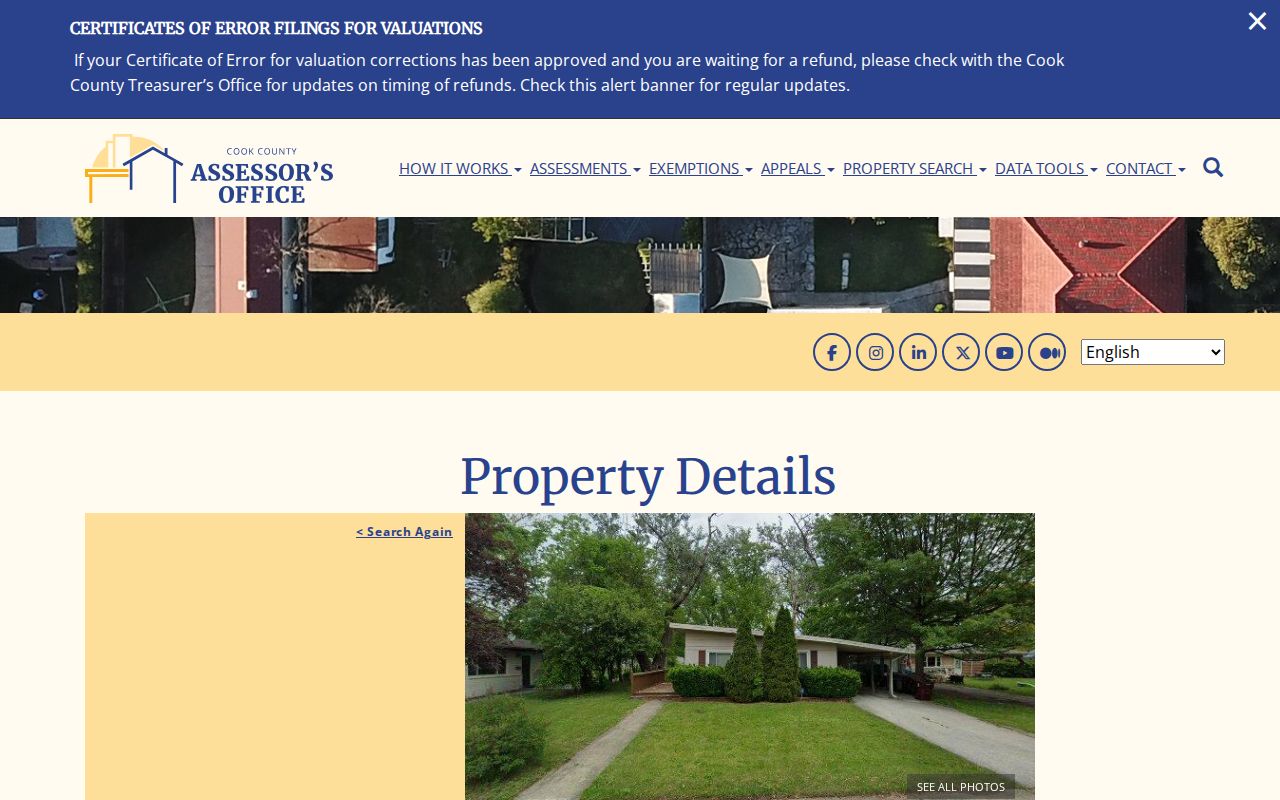
Its property fields illustrate why the parcel identifier and source date belong beside every name found later in the chain.
| Source | Years or era | Where held | What it can show |
|---|---|---|---|
| Cook recorded documents | Online database reported from 1985 | Cook County Clerk Recordings | Grantors, grantees, instruments, and parcel links |
| Will deeds and plats | Web index typically 1965 onward; archive from 1836 | Will County Recorder | Transfers, document numbers, legal descriptions, and plats |
| Regional telephone book | June 1953 to June 1954 | Library of Congress images | Names, phones, and PF locality entries |
| Local street-address leads | 1957, 1960, 1963, 1964, 1965, and 1968 | PFPL and PFHS verification | Address-linked occupants in selected years |
| Released federal census | Subject to the 72-year release rule | Library genealogy databases and archives | Date-bounded households and relationships |
| Village permit records | Coverage start not published | Building Department, BS&A number search, or FOIA | Work, applicants, inspections, and address activity |
Start with deeds for an ownership chain. For who lived here before, test each transfer period against a directory or census year. The lack of a complete published Park Forest directory run is important: a missing entry may reflect a gap in the surviving set, not an empty house.
Park Forest Previous Residents Start With PIN
Confirm the county before following any name. Park Forest crosses Cook and Will Counties, and each side uses a different parcel system. The Cook County Assessor search accepts a PIN or street address, while the Will County property portal also offers owner, sale, subdivision, and class modes. Copy the PIN, situs address, township, and legal description exactly.
A situs address is the location used for the parcel record. It may differ from the tax mailing address, and Cook expressly warns that its property location is not a legal or postal mailing address. That warning matters when names differ. A trustee, estate, corporation, or owner who receives mail elsewhere may appear on title, while past residents appear only in directories or census records.
Note: Park Forest street text can change across postal, tax, and historic sources, but the PIN and legal description keep the parcel trail stable.
Trace Park Forest Previous Owners
The deed chain works from the newest recorded transfer toward the oldest. Cook recorder duties moved to the County Clerk in 2020, so older references to the Recorder now lead to Cook County Clerk Recordings. On the Will side, the Recorder's search methods include free Direct Search, subscription Laredo, and pay-as-you-go Tapestry. The web cutoffs differ, so record the county with every result.
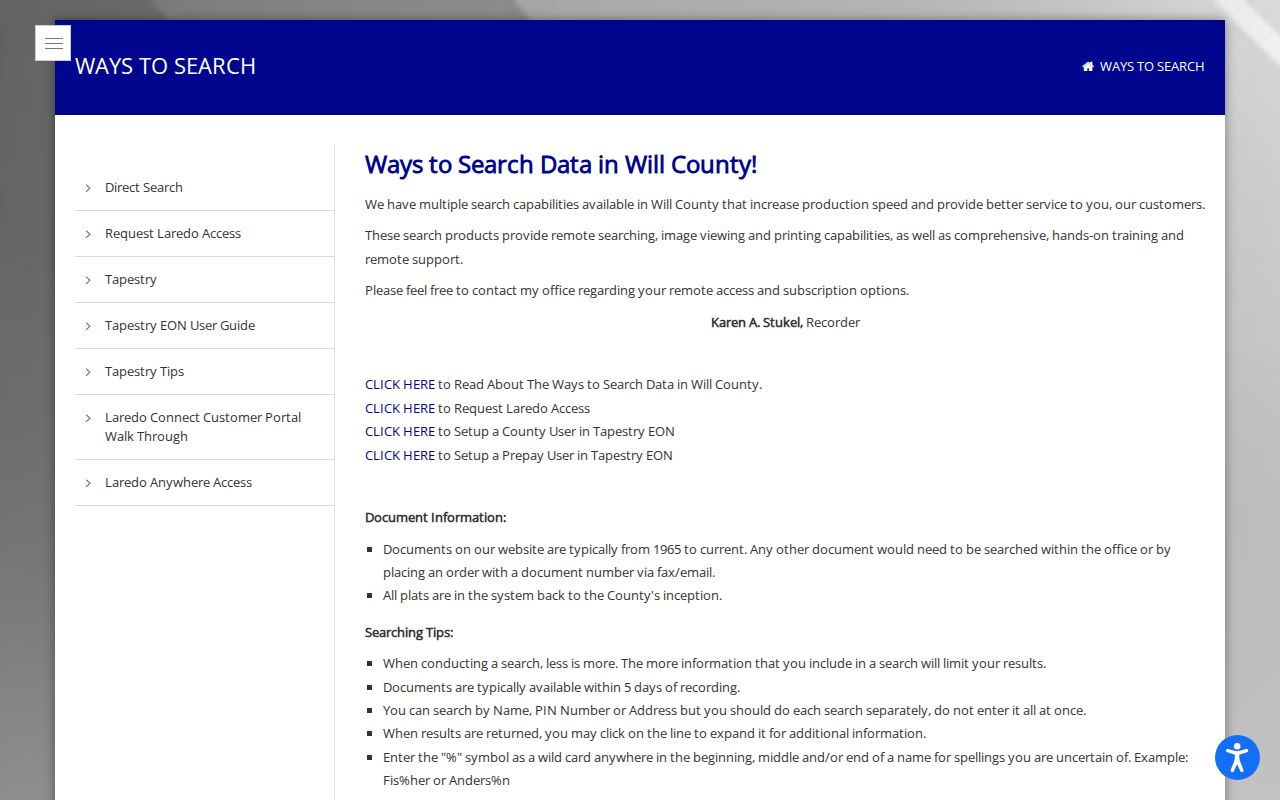
The captured Recorder page shows the search routes that support a backward Park Forest deed chain, including the free and archive options.
- Open the assessor record and save the present PIN, owner or taxpayer name, situs label, and legal description.
- Find the current owner's purchase deed. Note its document number, recording date, grantor, grantee, and parcel text.
- Search the seller as a grantee. That earlier purchase should name the owner before that seller.
- Repeat the name-role switch, checking the legal description at each transfer instead of relying on the street line alone.
- When the web index ends, take the names, date range, address, PIN, and document type to the archive or counter.
- Grantor
- The person or entity transferring an interest in a recorded document.
- Grantee
- The person or entity receiving that recorded interest.
- Chain of title
- The linked sequence of recorded transfers for one parcel.
- Legal description
- The formal lot, subdivision, or metes-and-bounds text that identifies land even when its street address changes.
Park Forest Resident Deed Cutoffs
Cook's online recording database is reported as covering 1985 to the present. If a Park Forest chain reaches that edge, contact the Cook recording help desk or remote county archives rather than guessing. The Cook Historic Archives and Records Office is closed to walk-in research but accepts remote reference requests. Copies and certified records follow the current Clerk fee schedule.
Will's online index typically reaches 1965 to the present, while the Recorder holds county documents from 1836. The Will Recorder Archives and Copies service has computers, microfilm, indexes, books, plats, and maps at its Joliet office. Staff can help begin a focused search, but they do not conduct open-ended research. Supply the names or trust, date span, instrument type, address, and PIN. An R95 document number is the simplest copy key.
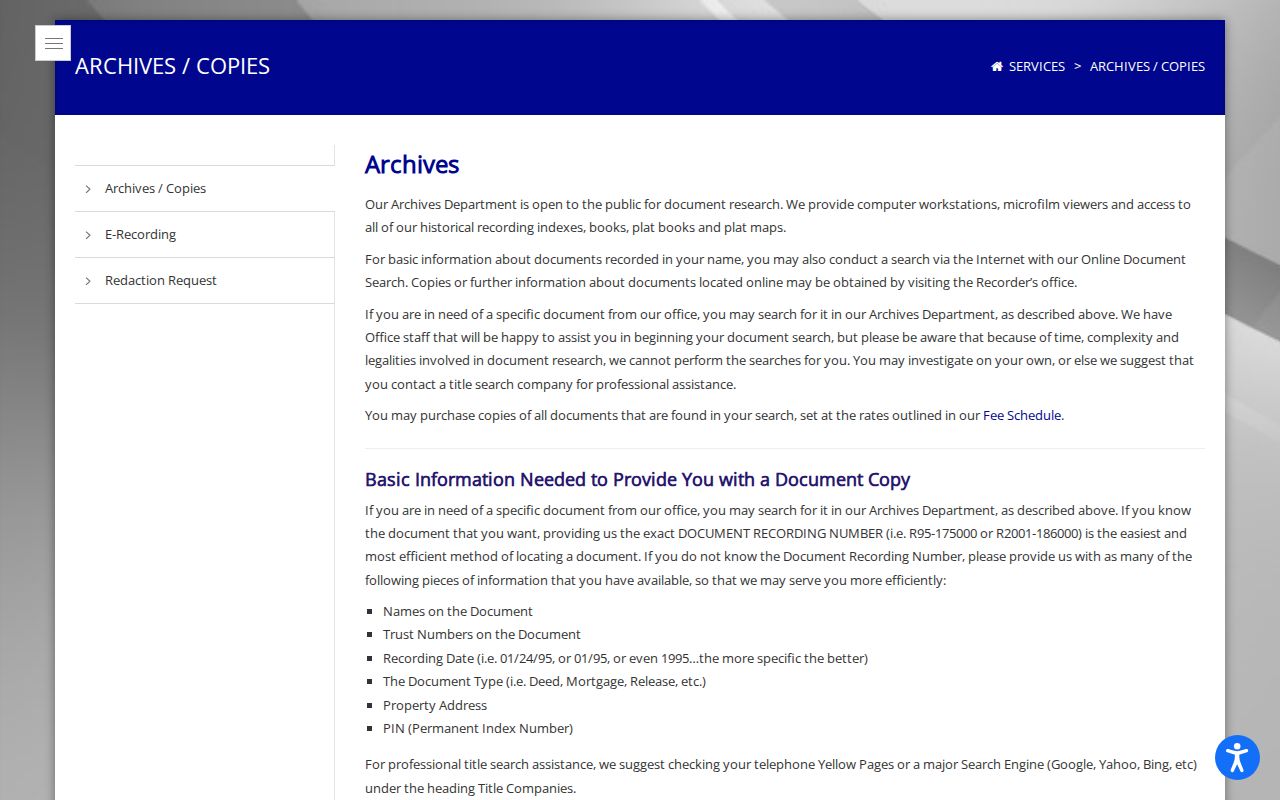
This archive view marks the handoff from the web index to older books, microfilm, plats, and staff-assisted copy requests.
The county dates predate Park Forest. That is not a conflict. The planned community's first move-ins occurred in 1948 and incorporation followed in 1949, yet older deeds and plats may describe the land beneath a later Park Forest parcel.
Park Forest Previous-Resident Files
The Park Forest Historical Society files provide the local layer that county indexes lack. Named subject files include Directories, Census, Streets, Maps, Incorporation, Home Tour and Remodeling Fair, churches, clubs, officials, and local newspapers. The cabinets are available through Park Forest Public Library Adult Services at 400 Lakewood Boulevard. Call ahead because some questions require a historical society researcher, and work beyond 30 minutes may carry a research fee.
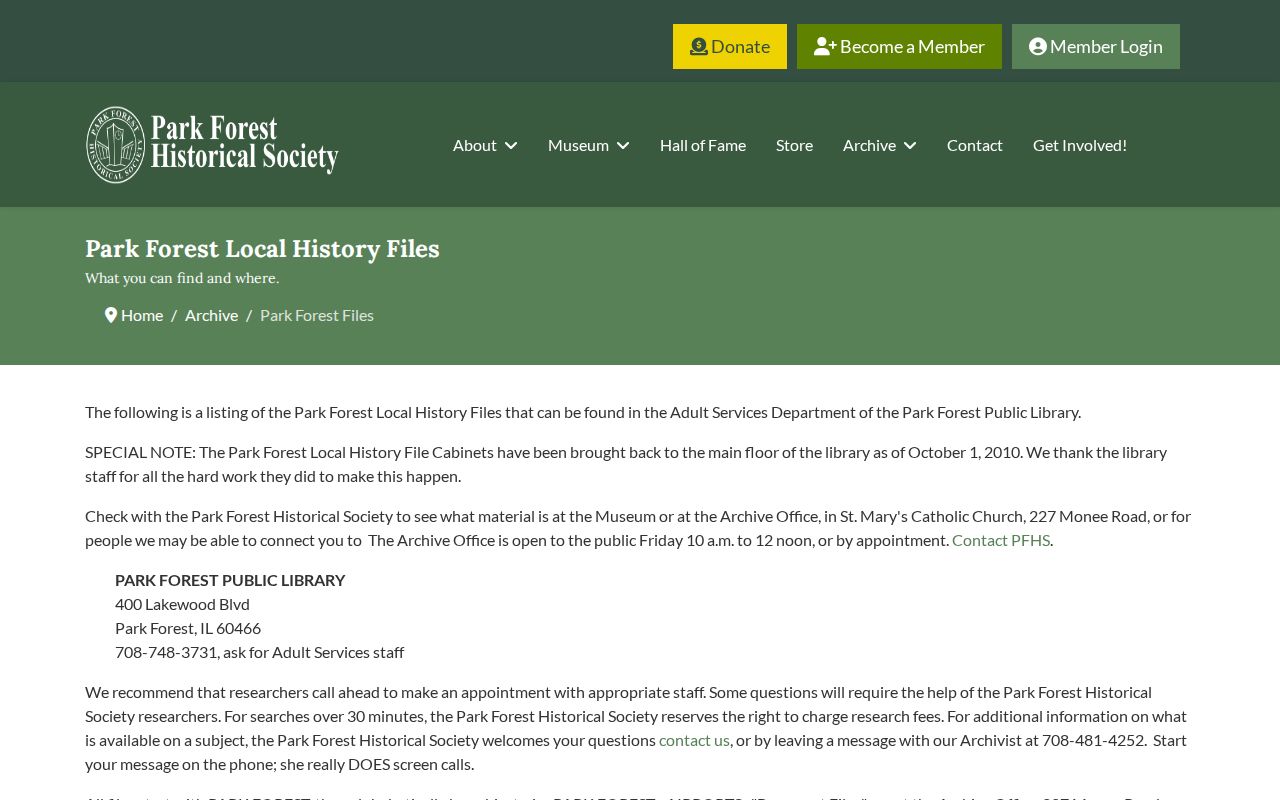
The archive file list gives researchers named collections to request instead of asking broadly for every record tied to an address.
The Society archive at 227 Monee Road is open Friday mornings or by appointment. Its collection began in 1980 to 1981 through Park Forest library reference work and now holds more than 5,000 photographs, slides, and negatives, plus oral histories, maps, government files, directories, and organization records. These sources can place a surname on a home tour, club event, street file, or photograph after the deed trail supplies the right date.
The 1950s House Museum at 141 Forest Boulevard preserves an original early townhome setting. It is not an occupant database, but it helps interpret early building types, maps, photographs, and home files. That local context is especially useful for previous residents tied to the first postwar development era.
Pair Park Forest Directories With Census
Directories supply a narrow snapshot. Census schedules supply a larger, date-bound household. Use both without treating either as a continuous roll. The 1953 to 1954 Illinois Bell regional book uses the PF locality abbreviation, while local street-address leads exist for several years from 1957 through 1968. Full collection details belong on the Park Forest city directory page.
- Choose the directory year closest to a deed transfer and search both the surname and the house number.
- Record the printed locality code, page image, telephone listing, and all spelling or initial variants.
- Find the nearest released census year, then confirm the township and enumeration geography for that period.
- Compare named household members with newspapers, yearbooks, obituaries, or probate records before drawing a conclusion.
A criss-cross directory is arranged by address or telephone rather than only by surname. An enumeration district is the small census-taking area used to locate a schedule. Both tools can reveal past residents who did not own the property, but neither proves uninterrupted occupancy between publication dates.
Park Forest Previous-Resident Permit Clues
Village permits add activity dates to the address timeline. Applications may relate to roofing, sewer work, paving, additions, inspections, or code matters. The public Park Forest BS&A portal searches Building Department records by permit, enforcement, certificate, PZE process, or invoice number. It does not provide a complete address-browse index or a published start year.
When no number is known, ask Building and Community Development for the exact address, permit type, and date range. Requests may be made through the department or under Illinois FOIA for releasable records. Applicant, owner, or contractor fields can support a date already found elsewhere, but a contractor name does not show who lived there. Keep permit evidence in its proper role.
Note: Ask for electronic copies and a narrow date range when the public permit search cannot begin from a street address.
Where Park Forest Resident Trails End
Newspapers and probate records often explain why a name disappears from an address. PFHS reports Park Forest Reporter microfilm from 1949 through 1976 and Park Forest Star or Southtown Star material from 1976 onward. Park Forest Public Library databases include Chicago-area newspaper collections. Search an exact name with the street, spouse, school, club, or subdivision when a common surname creates false matches.
Obituaries may connect relatives, former addresses, and a later community. Probate files can identify an estate or heir relationship. No complete Park Forest municipal interment index or verified local funeral-home archive was found, so use the cemetery, funeral home, newspaper, or court custodian directly. Absence from an online index is not proof that no record exists.
Lawful Park Forest Previous-Resident Research
Previous residents research is best used to understand a house, reconnect family history, settle an estate question, or identify the source of an old photograph or document. State and county custodians may withhold protected details. Public property data can also be stale, and a tax-mailing name is not a live household roster.
Preserve the source and date for each name. Do not publish a protected address, infer who currently lives inside, or use nearby records to rebuild information a custodian has withheld. The Illinois Address Confidentiality Program gives eligible people a substitute mailing address, but it cannot erase public records created before enrollment.
Lawful use. Use Park Forest previous-resident records for house and family history. Never track, threaten, harass, or harm a living person.